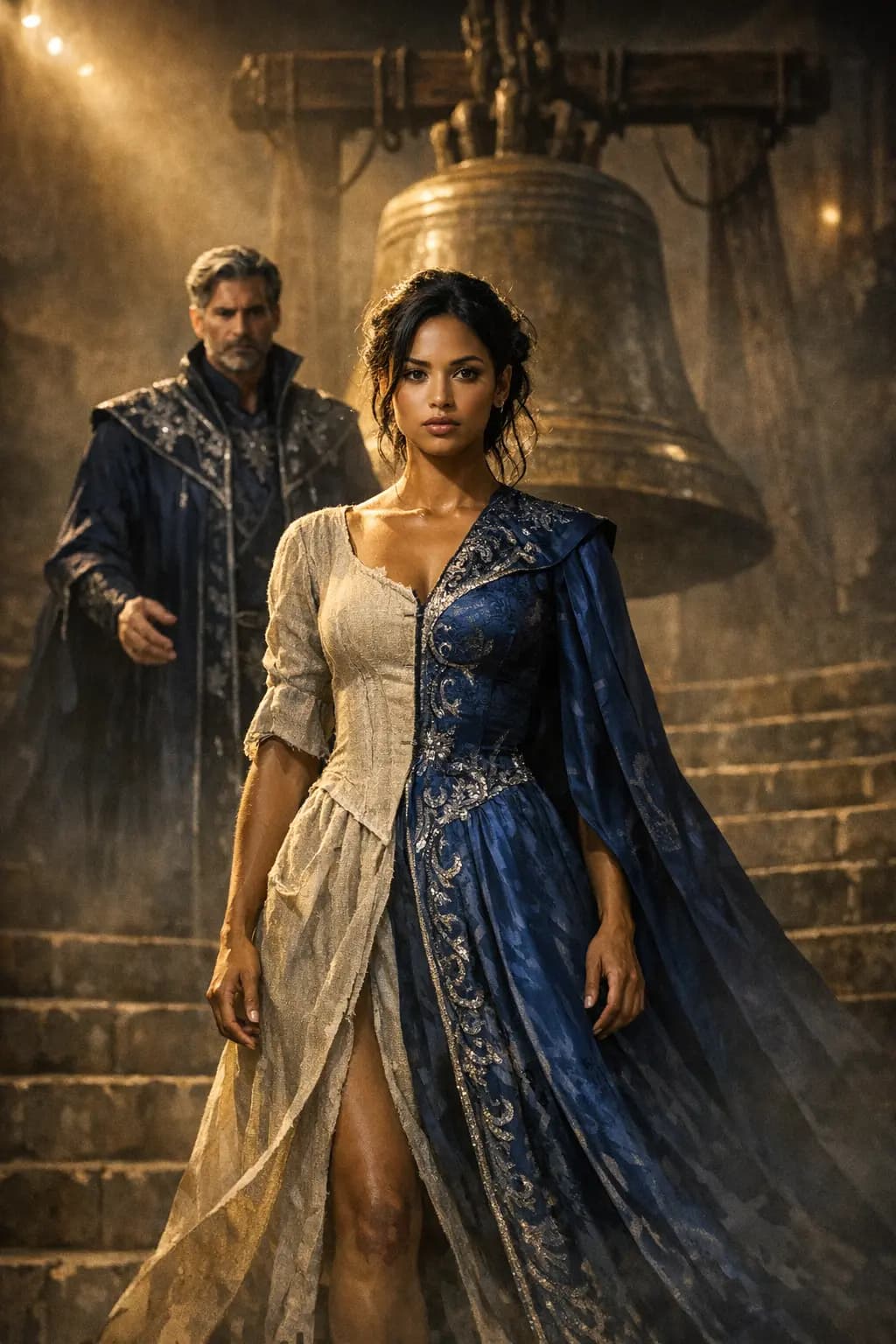
The Understudy
883 likes1.4K reads
The Understudy
Author
Theodora Kain
Reads
1.4K
Chapters
40
RomantasyFantasyDark Romance
RomantasyFantasyDark Romance
She was supposed to die on that stage. I was supposed to watch. Neither of us got our ending.
The princess died in the second act.
I know this because I was counting acts. I always count acts. Eight years of standing in the wings will teach you to measure time not in minutes but in scenes, not in breaths but in cues, and the cue for the second act of the Trial of Masks was a sustained note on the ceremonial horn that I had heard four hundred and twelve times in rehearsal and exactly once in performance before Solenne Varell's knees buckled and the blood began to spread across the stage like a curtain falling in the wrong direction.
She was wearing the coronation gown. Eleven pounds of embroidered silk that I had carried from the seamstress's chambers that morning, through three corridors and one locked door, and I had counted every ounce because counting is what understudies do. We count. We measure. We memorize the precise angle at which a princess holds her chin so that if the unthinkable happens we can hold ours at the same angle and no one in the audience will know the difference.
The unthinkable was happening.
The Court was screaming. Two hundred voices in a stone amphitheater make a sound like the inside of a bell, and I stood in the wings and listened to it ring and ring and ring while Solenne's blood soaked through eleven pounds of silk and turned the gold thread dark.
The Master of Ceremonies stood at the judges' bench. His hand hovered over the ceremonial bell. The bell that begins a Trial. The bell that ends one. His hand did not move. Three hundred years of Tournaments, and
I did not know his name yet. I knew his title. Everyone knew his title. The Master of Ceremonies was not a man. He was an institution, a voice that announced each Trial with the same measured cadence, a figure in midnight blue robes who had presided over eleven successions and outlived every sovereign he had crowned. He was architecture. He was the stage itself.
His hand hovered. The bell did not ring. And Solenne was dying in the eleven-pound gown I had pressed that morning with an iron I heated myself because the palace laundress didn't understand the silk and I did, because understanding silk was all I had ever been trusted to do.
Someone said my name.
Not the name the Court knew, if the Court knew me at all. My real name, the one my mother had given me in the theater district, the one I answered to in rehearsal rooms and costume workshops and the narrow corridor backstage where the understudies waited for catastrophes that were supposed to be theoretical.
"Ysabel."
I looked at the director of the Trials. He was pale. His hands were shaking. Behind him, the stage was a ruin of blood and silk and screaming.
"There is no one else."
I walked onstage.
I walked onstage because there was no one else, and because the part was mine whether anyone in this Court knew it yet, and because the blood on the boards had not yet dried and Solenne Varell deserved a second act even if she could not perform it herself. My shoes were wrong. My hair was wrong. I was wearing the plain gray shift of an understudy, the costume of invisibility, and every eye in the amphitheater was on me and the gown I was not wearing and the princess I was not.
I found the mark. Center stage, two paces left of the blood. The boards were warm under my feet. Stage lights from above, gold and merciless, and beyond them the darkness of two hundred faces, the judges' bench, and the Master of Ceremonies with his hand still suspended over a bell he had not rung.
He was looking at me.
Not at the stage. Not at the blood. Not at the catastrophe. At me. At the common-born girl in the gray shift who had walked into the light because someone had to.
I opened my mouth. The Trial of Masks requires the candidate to perform three identities in sequence: the warrior, the mourner, the sovereign. Solenne had completed the warrior. She had begun the mourner. She had been beautiful. She had been perfect.
I began the mourner from the exact line where she fell.
The Court went silent. Not the silence of shock, which they'd been drowning in. A different silence. The kind that happens when an audience realizes they are seeing something they did not expect and cannot look away from.
I performed the mourner. I performed the sovereign. I did not perform Solenne. I performed myself, in Solenne's role, wearing my own grief as a costume because it was the only costume I had.
When I finished, the silence held for four seconds. I counted them. Understudies count.
Then the Master of Ceremonies lowered his hand from the bell. He had not rung it. He had not stopped me. In three hundred years of Tournaments,. Had never permitted an unauthorized performance to continue.
He looked at me across the length of the stage, across the blood and the silk and the silence, and his face broke its own architecture, the composure splitting along a fault line that three centuries had not prepared for.
The Court erupted.
I stood in the light. Let them scream.