Just a Weakling
1.5K likes2.4K reads
The verdict took seven minutes.
I had expected longer. I had also expected to feel something during it, and what I got instead was the fluorescent light above the jury box, which buzzed at a frequency just slightly above the room's air-handler. The two pitches did not agree. I had been listening to them disagree for two days, the way I had been listening, for nine weeks, to my own engagement ring chime against the ceramic of every diner mug I had been served by federal staff.
The judge said the word "guilty" three times, once for each count. The marshal beside me did not move. The man on my left, the public defender whose name I could no longer remember reliably, took half a step away from me at the second "guilty." He was already revising his memory of who I had been across the table from him for nine weeks.
At twenty-seven, I had been a software engineer. The kind who proofread her partner's code on Sunday mornings without being asked. The judge would not be told that, or that the access logs I was being convicted of falsifying were the same logs I had, eleven months earlier, filed a routine query against, and never finished, because Marcus had asked me to make him coffee instead.
Outside, a bailiff pressed a hand to my elbow. It was a polite touch, calibrated. He had touched many guilty women.
In the elevator, I counted the floors. There were eleven. I do not know why an elevator in a federal building needs eleven indicator lights when the building only has six floors, but I noted it, because it was the kind of detail I would have logged in a postmortem at work. I would have written Display element exceeds physical state space. Recommend audit.
I would not be writing postmortems anymore.
The intake room at Penumbra was painted the wrong blue. I had only been inside corrections facilities in case studies, but I had assumed they would commit to one of the two regulation greys. Penumbra had instead chosen a blue that aspired to calm and arrived at clinical. The intake officer wore the same blue, sublimated into her uniform, so that she looked like a nurse and an enforcer at once. She did not look up.
"Renn, Adair. Female. Twenty-seven. Three counts."
"Yes."
"Recursion candidate. Standard pathway."
"Yes."
She slid a tablet across the counter. The forms were standard, acknowledging that death within the simulation registered as neural cascade failure in the body, that the body could not be reliably recovered from such failure, and that survivors of the full seven-level program would be released into supervised parole.
Somewhere in the fine print, the word humane.
I signed.
"Hair down. Shoes off. Personal items left at intake. Pod assignment is in your hand."
I looked at my hand. There was no pod assignment in it. There was a wristband. The wristband had a number. The number was 0741.
"Apparently," I said, "I am 0741."
She did not respond. She had heard the joke before. I had also heard the joke before, in the version where I made it, three years ago, when Marcus came home with a parking-lot ticket and called himself a felony. He had laughed at his own joke for forty seconds, because he thought I thought it was funny. He had been right.
I closed my hand around the wristband and the wristband closed itself around my wrist, and that was the last gesture of my old life, a small mechanical agreement between an object and my body that I had not been asked to consent to.
They walked me to the pod wing.
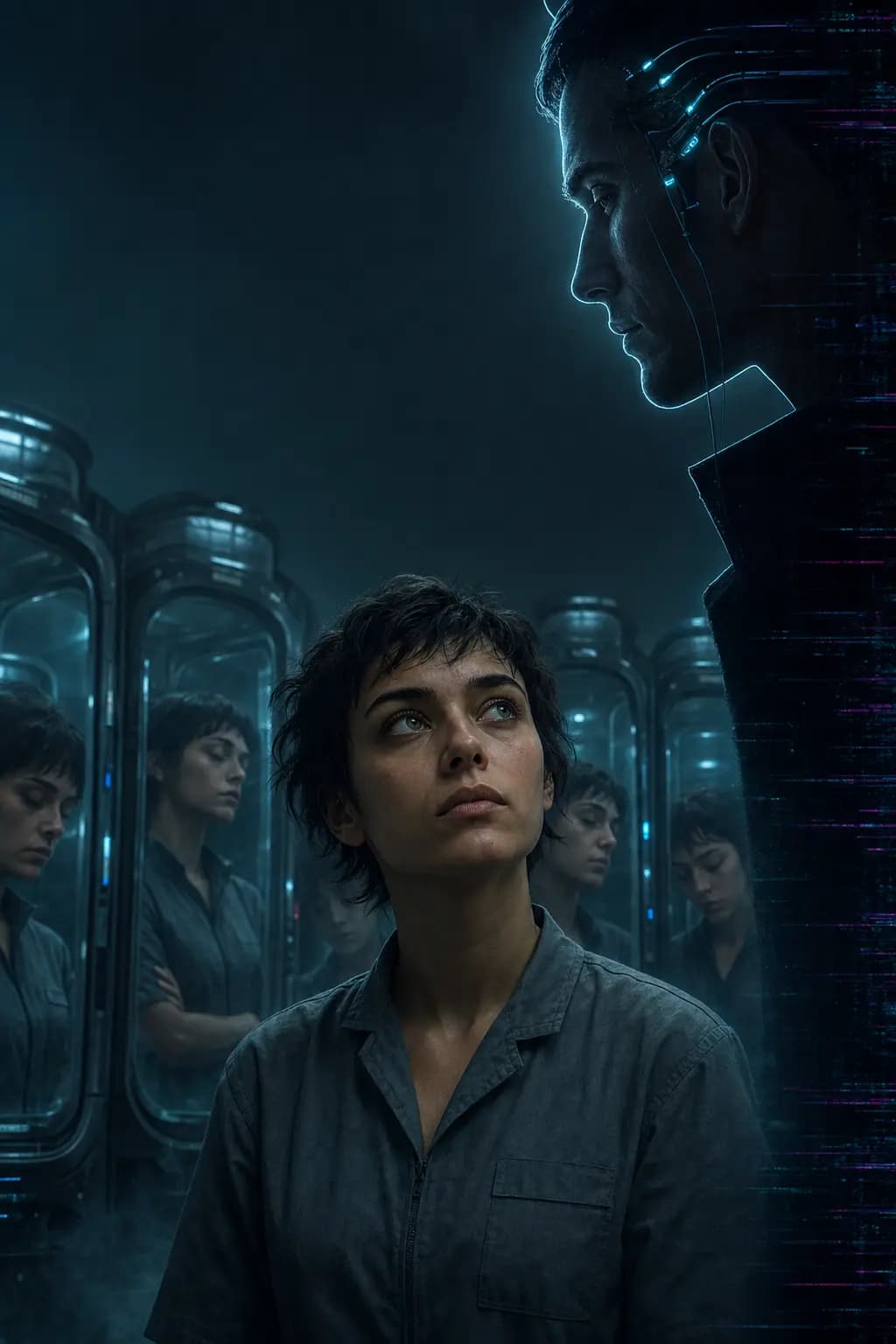
The wing was a hallway lined with glass-doored pods, each pod the size of a coffin standing upright, each pod with a number above its door. The numbers ran out of order. 0741 was between 0732 and 0744. I did not ask why. I would have asked, at work. At work, I had been the kind of engineer who asked. At work, I had also been the kind of woman who, on the morning of her arrest, had been wearing her own ring and her partner's hoodie and had been, for the first time in months, considering whether the second of those things still felt like a borrowing or a possession.
The technician was a thin man with kind eyes and the careful posture of someone who had been told to seem careful. He attached the leads. The leads were thinner than I expected. He explained, while he worked, that I would not feel the connection. He explained that I would feel everything else.
"Heart rate's high," he said. "That's normal."
"It would be alarming if it weren't."
He almost smiled. He was not allowed to. The pod hissed and accepted me, and the glass closed, and the light inside the pod was the same wrong blue as the intake room, and then it wasn't.
The light dropped. The temperature dropped with it, by exactly enough to make me forget that I had been temperature-controlled to begin with. My weight shifted, which was the first thing the sim got wrong, because bodies in pods do not have weight. Then my weight was on my feet. Then I had feet.
I was standing in a street.
The street was not a street, but the sim wanted me to think it was, and so the sim assembled it from a Mediterranean reference set: bleached stucco, a balcony with a bicycle chained to it, a campaign poster for someone whose face was supposed to be reassuring. The sun was the wrong color. The shadow it cast was the right one.
A wind moved past me carrying dust. The dust was correct, and it got into my mouth.
Far down the street, an artillery shell landed. I watched it. The shell was distant enough that the sound arrived afterward, the way physics required, and the sim had been correct about that, too. I felt the percussion in my ribs. I did not move.
I had read enough about Recursion to know that Level 1 was modeled on a six-year urban conflict in a country I had only seen in the news. I had not expected the bicycle on the balcony. The bicycle made the street believable in a way the campaign poster did not.
I noted that.
I was still noting it when the man stepped out of the doorway across from me.
He was tall and very still. The stillness was the first thing I registered, because nothing in a war zone is still. People in war zones move, and the things they carry move, and the air around them moves whether or not they want it to. He did not move. He had black hair, military-short, and pale grey eyes the color of an unfilled field on a form, and a uniform whose insignia I did not recognize, and gloves, and a sidearm holstered in a way that suggested he never needed to look down to find it.
He looked at me.
He looked at me like he knew who I was, which was unreasonable, because I had been in this street for less than ninety seconds, and we had not been introduced.
I waited for him to speak. He did not. He kept looking.
Then he raised one gloved hand in a sharp signal, not at me, past me, and I realized too late that I had been hearing a second shell since before he stepped out of the doorway. The shell was closer than the first one. The shell was, in fact, currently above the building behind me.
He covered the distance between us in the time it took my brain to finish that sentence. He took my elbow. He did not pull. He turned with me, fast, the way you'd close a door before a storm, and the doorway he had come out of was suddenly the doorway we were standing inside of, and the street outside became a wall of brown air and the building behind me became a building that had been there until very recently.
He released my elbow.
He stepped back.
He did not say anything.
He looked at me one more time, the same way, and turned to face the open doorway, and stood with his back to me as if to imply that we had not just touched.
The quiet of the doorway had a new sound in it, which was the blood in my ears. The dust in my mouth had become a paste. The doorway smelled faintly of bread and cordite, a combination the sim should not have been able to fabricate from any reference set I knew.
I took inventory, because I am not a person who panics, and because taking inventory is what I have always done with a frightened body. The inventory was unhelpful. The inventory said: stranger, weapon, debris field, no exit. The inventory did not say what I most wanted to know, which was why the man with the unfilled-form eyes had looked at me the way you look at someone you used to know.
I had never seen him before in my life.
"Apparently," I said, into the back of his shoulder, mostly to myself, "this is the program."
He did not turn around. But the angle of his head shifted, just enough to indicate that he had heard. He did not say anything. He did not need to.
The thing the inventory could not catalog was already happening. Somewhere on the other side of the wall the sim had just rebuilt, the second module was loading. Somewhere on the outside of the wall, in a building I would not see for twenty-one days, the man I had been engaged to was watching my readouts on a panel he had paid for the access to.
What did he want me to see in here?