Monster of the Year
3.2K likes5.2K reads
The thing chasing me through the warehouse used to be a man, and my left shoe was filling with blood. The air stung with the sour tang of rust, my calf throbbing where something jagged had bitten into flesh. My sneakers slapped wet against cracked concrete, each step squelching, the coppery warmth seeping into my sock.
I knew he used to be a man because I had watched him sign my loan papers in a back office in Bushwick eight months ago. His name was Marcus. He had a chin tattoo of a dolphin. He had charged me twenty-seven percent interest and complimented my hoop earrings.
He did not look like Marcus anymore.
His face was Marcus from a distance. Up close his teeth were too long, his eyes the wrong color in the streetlight, and the air around him smelled like burnt sugar, cloying and thick, sticking to the back of my throat. Whatever was riding Marcus was not what had been at his desk eight months ago. Something had moved in.
"Maeve, sweetheart," not-Marcus called, calm and slow, like a guy talking down a kitten in a tree. "You're making this so hard."
Okay. So.
The plan, when I came up with it earlier this evening, was to get on the BoltBus to Philly with the eight hundred and forty dollars I had managed to scrape together by pawning my Nana's watch. The plan was good for about forty minutes. Then two of Marcus's regular guys, the human ones with neck chains, found me at the bus station, and the only direction I could run was deeper into the industrial zone, where the streetlights stopped working and the warehouses said CONDEMNED in red spray paint.
The regular guys turned around at the gate.
They were big men. The kind of big where I had personally watched one of them break a folding chair last spring. They had chased me for ten blocks. They were sweating and pissed and one of them had pulled out a knife.
They stopped at the gate.
They looked at the warehouses past the fence, at the dead streetlights, at something in the dark I couldn't see, and they turned around and walked back the way we'd come.
That should have been my first sign.
The second sign was that the not-Marcus thing did not turn around at the gate. He sauntered through it. He did not look at the warning signs. He did not look at the dead halogen lamps. He looked, mostly, at me.
The third sign was that I tripped over a chunk of broken concrete and gashed my left calf on something rusty, and when I came up running my shoe started filling with blood and I did not have the time or the budget for a tetanus shot.
I rounded the back of the warehouse. There were heavy iron doors. There was a sign on the doors, and underneath the larger warning, much smaller, in letters that should not have been visible in the dark, it said:
ENTER WITH CONTRACT ONLY.
I did not have a contract. I had a half-eaten granola bar and the eight hundred and forty dollars and Nana's watch was already gone.
The doors opened.
They opened from the inside. Someone pushed them. A figure stepped halfway out, looked at me, looked over my shoulder at not-Marcus, looked back at me, and said, in the most bored voice I had ever heard, "Coming through?"
I went through the doors.
You would have gone through the doors. Don't lie. The not-Marcus thing was sixty feet behind me with the wrong teeth and the burnt-sugar stench, and the figure at the door was a girl in a hostess uniform holding a tablet and chewing gum, the sharp mint cutting through the stale air. I picked the gum.
The doors closed behind me.
The hostess said, "Aisle three. You're up."
"What?"
"Stage entry. Aisle three. They're ready for you."
I started to say I was not, in fact, ready for them, and that I was bleeding into my shoe, and that I had taken a wrong turn, and was the bathroom maybe through the side hall, when the hostess took my elbow with surprising strength, her grip cold and unyielding, and aimed me down a corridor, and the corridor opened up.
The corridor opened up into an arena.
The arena was packed.
The arena was packed with five thousand monsters.
I want to be very clear about this. I had been seeing things since I was six. I had thought I was insane since I was seven. Most humans couldn't see what I could see, which meant for twenty years I had been the only person in the room who knew the man with the fox face on the F train wasn't wearing a mask, or that the lady at the bodega had too many rows of teeth behind her smile, her breath hot with something rancid. I'd taught myself to treat them like regular commuters. To not flinch. To pretend I was the normal one.
I had never seen this many at once.
Creatures in the front rows didn't bother pretending to be human. Things in the back rows I couldn't look at directly. The ceiling opened onto a sky that should not have existed under a Brooklyn warehouse, a low hum vibrating through the air, like a tuning fork struck deep in my chest. Banners hung down, curling symbols. Cameras everywhere.
And a stage.
The hostess shoved me, gently, toward aisle three, her palm lingering at my shoulder, a brief press of unexpected heat through my thin jacket.
I went down aisle three.
I went down aisle three because the alternative was to back out into a hallway where the not-Marcus thing might catch up, and at this point I was choosing my monsters.
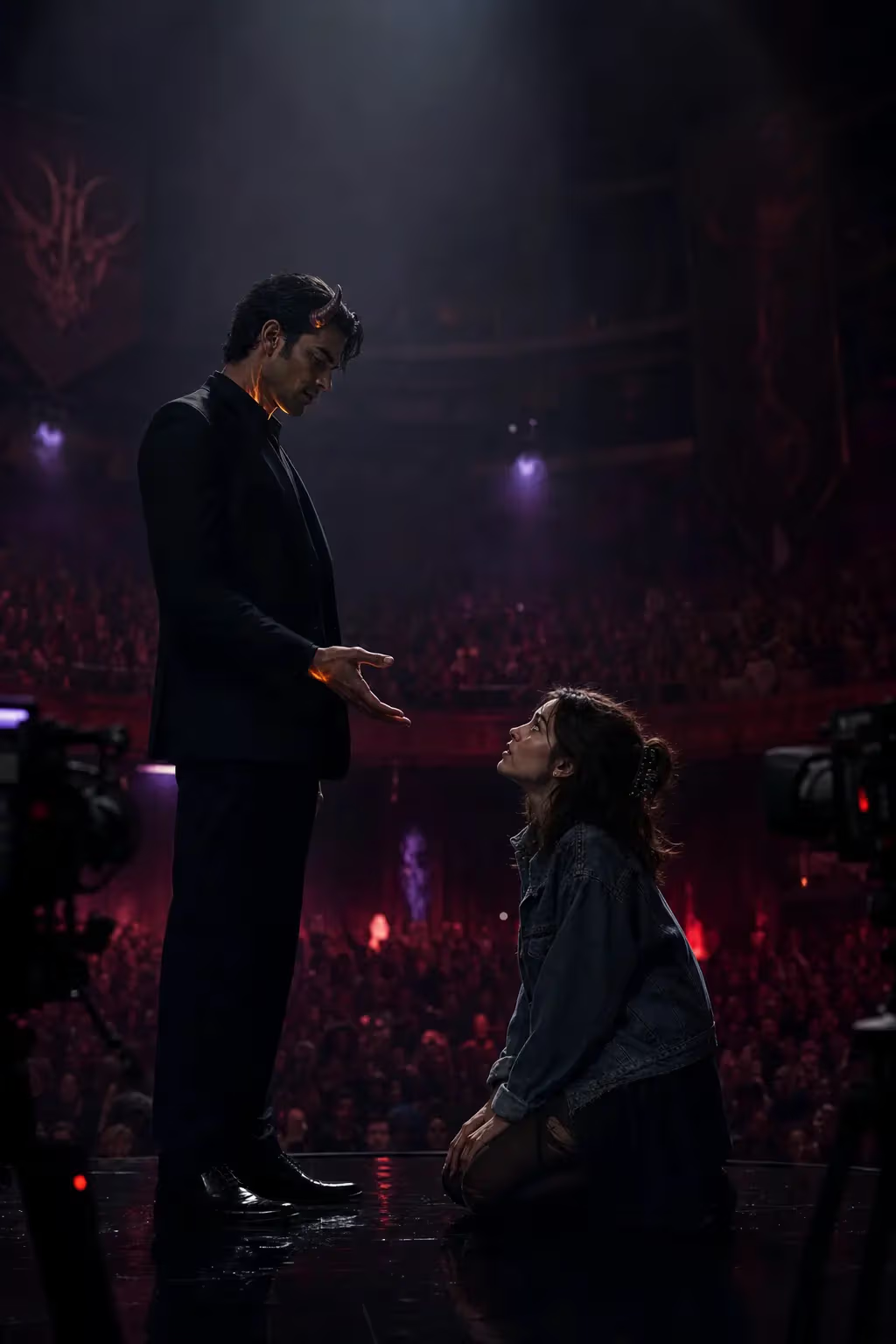
At the bottom of aisle three the polished floor changed from dark wood to black glass, slick under my soles, reflecting the chaos above in fractured shards. I realized I was already on the stage, and there was a man at the center of it.
The air pressure in the arena changed.
Not a sound. A feeling. In my teeth, my spine, the fillings I hadn't gotten replaced. The air gained weight, pressing against my skin like a humid night, heavy with intent. The crowd went still. My pulse hammered at my throat, my own breath shallow, the ache in my calf sharpening under that invisible force.
He was in a black suit. The kind of black suit you see in luxury watch ads. Tall. Six-five, easy. He was alone in the middle of the stage with his hands clasped loosely behind his back like a private banker giving a speech he had given a hundred times.
The lights were dim around him because the cameras did not need light to find him, and yet I felt the heat of his presence, a slow burn that licked at the edges of my awareness, unasked for, undeniable.
I tripped.
I tripped on absolutely nothing. The hem of my jeans, maybe. My own bleeding shoe. I went down on one knee, then on both knees, on the polished black-glass stage, four feet from the man in the suit, with five thousand monsters watching and the cameras zooming in. The impact jarred through me, sharp pain blooming at my kneecaps, the cold of the glass seeping into my palms as I caught myself.
He looked down at me.
His hair, I noticed, before I noticed anything else, was very nice. Black, cut short, a little wave to it. His eyes were brown with amber in them, and he was looking at me like he had not seen a single new thing in eight hundred years and I was the first. The weight of that gaze pinned me, a physical thing, warmer than the stage beneath me, hotter than the blood drying sticky on my leg.
My skin prickled. My lungs forgot how to fill, ragged, as if the air itself had thickened just for me. I felt the space between us, four feet of nothing that somehow burned, a pull I didn't have a name for, my hands still pressed to the cold glass, trembling not from pain but from the sheer force of him looking.
"Your hair is nice."
The crowd gasped.
I had not meant to say that out loud. I had not, in fact, registered saying it out loud. My mouth had done something without consulting the rest of me, my voice rough, scraped raw from running, from wanting something I couldn't parse.
The man's mouth, which I had been told to stop noticing, did something. The corner of it. Not a smile. The shape underneath a smile. My eyes dropped to it, unbidden, and I felt the heat of that almost-smile like a touch, like fingertips brushing the nape of my neck, phantom and impossible.
He turned, slowly, to the host at the side of the stage, who had a microphone and an expression of theatrical horror.
He said, into the live broadcast, calm and clear, every camera catching it:
"I am claiming my Contest Entry Attachment."
The arena erupted.
Still on my knees.
Still bleeding into my shoe.
My body reacted before my brain did, a shiver rolling down my spine, heat pooling low in my gut at the sound of his voice, the weight of those words. Claiming. Attachment. They shouldn't have meant anything, but they landed like a brand, searing into the space between my ribs, my skin too tight, too aware of him standing there, unmoving, while the crowd roared.
Behind me, very faintly, I heard the iron doors swing open again, and not-Marcus's bored voice say, "Sweetheart? You in here?"