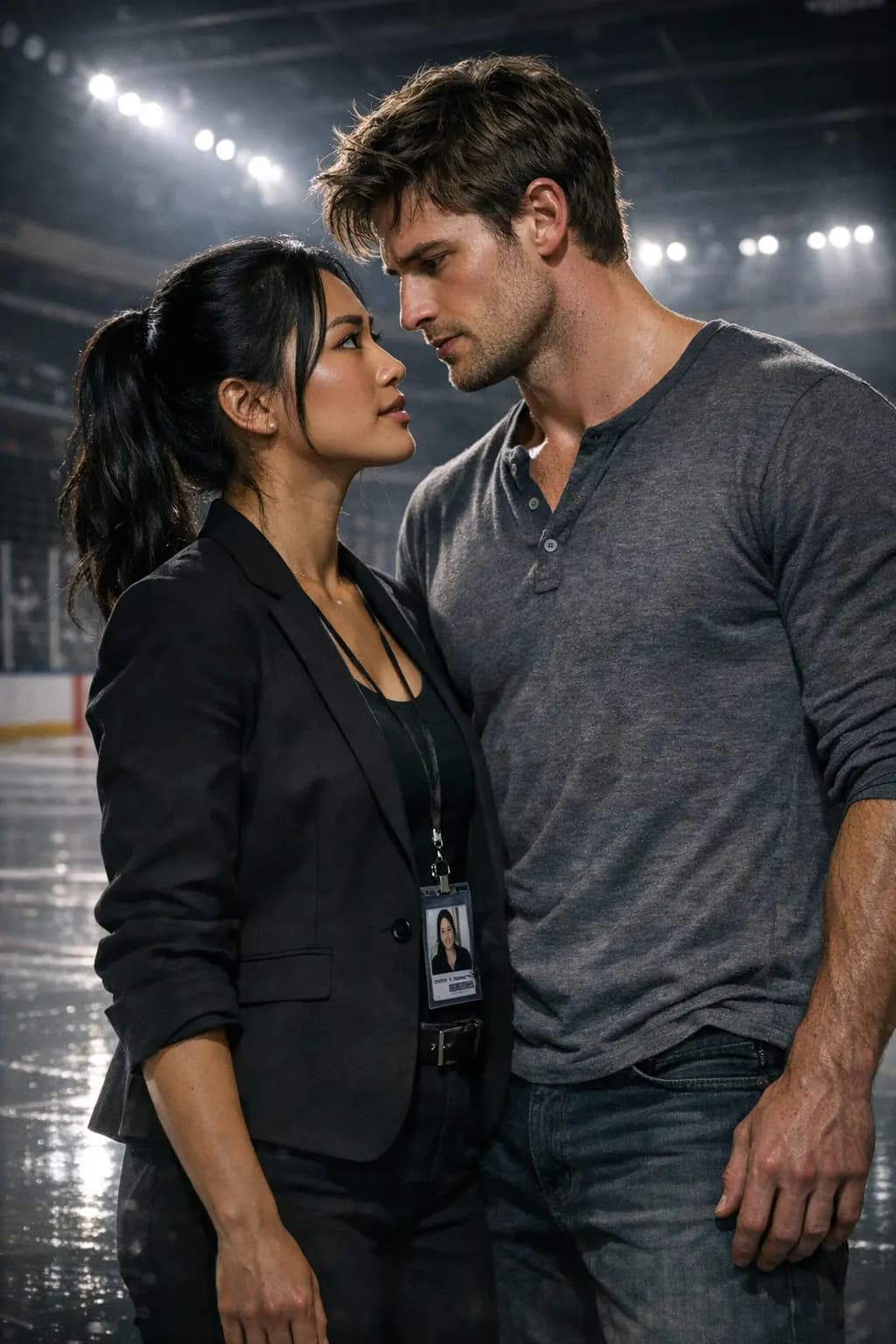
Offside Heart
2.2K likes3.5K reads
The Seattle Wolves' media room smelled like stale coffee and desperation, two things I understood intimately.
I found a seat in the third row, close enough to ask questions but far enough to escape quickly if needed. The other reporters settled around me, checking phones and adjusting cameras. Same faces I'd seen at a hundred press conferences over the past three years. Same small talk about standings and injuries and whether the Wolves had a shot at the playoffs this season.
I didn't participate. I'd learned that lesson.
The door opened. Coach Patterson entered first, taking his position at the podium with the practiced ease of a man who'd done this a thousand times. Then the players filed in, new captain at the front, per tradition.
Jake Lawson.
I'd seen him before. Of course I had. His face had been plastered across every sports site in the country three years ago, and not because of hockey. I'd memorized that face, the strong jaw, the gray eyes, the mouth that used to smile for cameras and endorsement deals.
He wasn't smiling now.
He was scanning the room, probably looking for familiar faces from the Seattle press corps. I watched him nod at Marcus Chen from ESPN, wave at someone from The Athletic, acknowledge the radio guys with a casual gesture.
Then his eyes found me.
The transformation was immediate. His expression went from casual captain to something cold. Something that remembered exactly who I was and what I'd done.
Coach Patterson started talking. I didn't hear a word.
Jake Lawson was staring at me like I'd crawled out from under a rock he'd thought was sealed. Like I was a headline he'd spent three years trying to escape, walking back into his life uninvited.
I stared back. What else could I do?
"and we're excited to have Jake as our captain this year," Patterson was saying. "He's been with the organization for two seasons now, and he exemplifies everything we want our team culture to be."
Two seasons. He'd been traded here after the scandal gutted his career in Boston. Fresh start, new city, another chance to prove he was more than a story.
A story I'd written.
"Questions for Coach Patterson or Captain Lawson?" The media coordinator gestured to the room.
Hands went up. Standard questions, training camp, new additions, playoff hopes. Jake answered with practiced ease, voice confident and warm. The media loved him. They always had, even during the worst of it. Charisma like his didn't fade with scandal.
Marcus from ESPN asked about the new power play system. Jake launched into tactical details, comfortable in his element. I wrote notes without really seeing them.
Then my hand went up. Automatic. Professional. The job didn't stop just because I wanted to disappear.
The coordinator pointed at me. "Riley Chen, Seattle Tribune."
The temperature in the room dropped ten degrees.
Jake's answer trailed off mid-sentence. He looked at me, really looked, and I saw three years of anger compressed into a single moment.
"No," he said.
Just that. No.
The room went silent. The coordinator blinked. Patterson's face went carefully blank.
"Captain Lawson..." the coordinator started.
Jake stood. Shoved his chair back from the table. The screech of metal on floor was the loudest thing I'd ever heard.
"We're done," he said.
Then he walked out.
The door slammed behind him. Thirty journalists stared at the empty seat. Patterson stood slowly, muttered something about schedule conflicts, and followed his captain.
I sat frozen in my chair while the silence stretched into infinity.
Someone coughed. Someone else whispered. The cameras that had been focused on the podium swiveled toward me.
"So," Marcus Chen said from two seats over, "I'm guessing you two have history?"
History.
That was one word for it.
I didn't run. I wanted to, every instinct screamed at me to grab my bag and flee, but I was a professional. Professionals didn't run from press conferences.
They waited until they were alone in their cars to fall apart.
The Seattle skyline blurred through my windshield as I gripped the steering wheel and tried to remember how to breathe. Jake Lawson had walked out of his own introductory press conference because of me. Thirty journalists had watched him refuse to answer my question, any question, because my name had been attached to it.
The video would be everywhere by morning. Riley Chen, the journalist who'd falsely accused Jake Lawson of doping, shows up at his new team's press conference. He walks out. The story writes itself.
Three years of rebuilding my reputation. Three years of careful, ethical, boring journalism designed to prove I was more than one terrible mistake. Gone in sixty seconds.
My phone buzzed. Sarah Kim, my editor.
Get to my office. Now.
The Seattle Tribune newsroom was half-empty at 6 PM, most of the day staff gone home while the night crew settled in. I made it to Sarah's office without making eye contact with anyone, which was probably for the best.
She was waiting behind her desk, reading glasses perched on her nose, laptop open to what I assumed was the press conference footage.
"Close the door."
I closed it. Sat in the chair across from her. Waited for the firing I probably deserved.
"That was..." Sarah paused, choosing her words. "Dramatic."
"I know."
"The entire hockey world is talking about it."
"I know."
"Lawson's PR team has already released a statement. 'Captain Lawson has no comment on Ms. Chen or her previous work. He looks forward to a successful season with the Wolves.'" Sarah set down her glasses. "Diplomatic."
"More than I deserve."
"Maybe." She studied me for a long moment. "Tell me why I shouldn't pull you off this assignment."
The assignment. My stomach dropped.
Two weeks ago, Sarah had called me into this same office to deliver what she'd framed as a gift: full season coverage of the Seattle Wolves. Every game. Every road trip. Every press conference. It was a plum assignment, the kind that went to senior reporters, not reformed cautionary tales.
I hadn't asked why. I'd just said yes.
Now I understood. Sarah wanted to know if I could handle being in Jake Lawson's orbit without imploding. Today's answer was apparently not encouraging.
"Because I can do this," I said. "I know how it looks. I know what happened today. But I'm good at my job, the job I've been doing for three years, the careful and ethical kind, and I can cover this team without making it about the past."
"Can you? Because from where I'm sitting, it looks like the past followed you into that press conference whether you wanted it to or not."
"That was his choice. His reaction." I leaned forward. "Sarah, I've spent three years proving I'm not that story anymore. Give me the season. Let me prove it again."
She was quiet for a long time. I could see her weighing the options, the liability of keeping me on versus the embarrassment of pulling me off.
"One condition," she said finally.
"Anything."
"You write about the team. The hockey. The season." Her eyes met mine. "Not about him. Not about your history. Not about redemption or forgiveness or any of the narrative garbage that'll get clicks. You're a sports journalist. Act like one."
"I can do that."
"We'll see." She turned back to her laptop, dismissing me. "Get me something on tomorrow's practice. Eight hundred words, deadline midnight."
I stood. Made it to the door before she spoke again.
"Riley?"
"Yes?"
"Whatever happened three years ago, whatever mistake you made, this is your chance to put it behind you. Don't waste it."
I nodded. Walked out. Made it to my desk before the weight of her words finally hit me.
My chance to put it behind me.
The problem was, Jake Lawson didn't look like he was ready to let me.