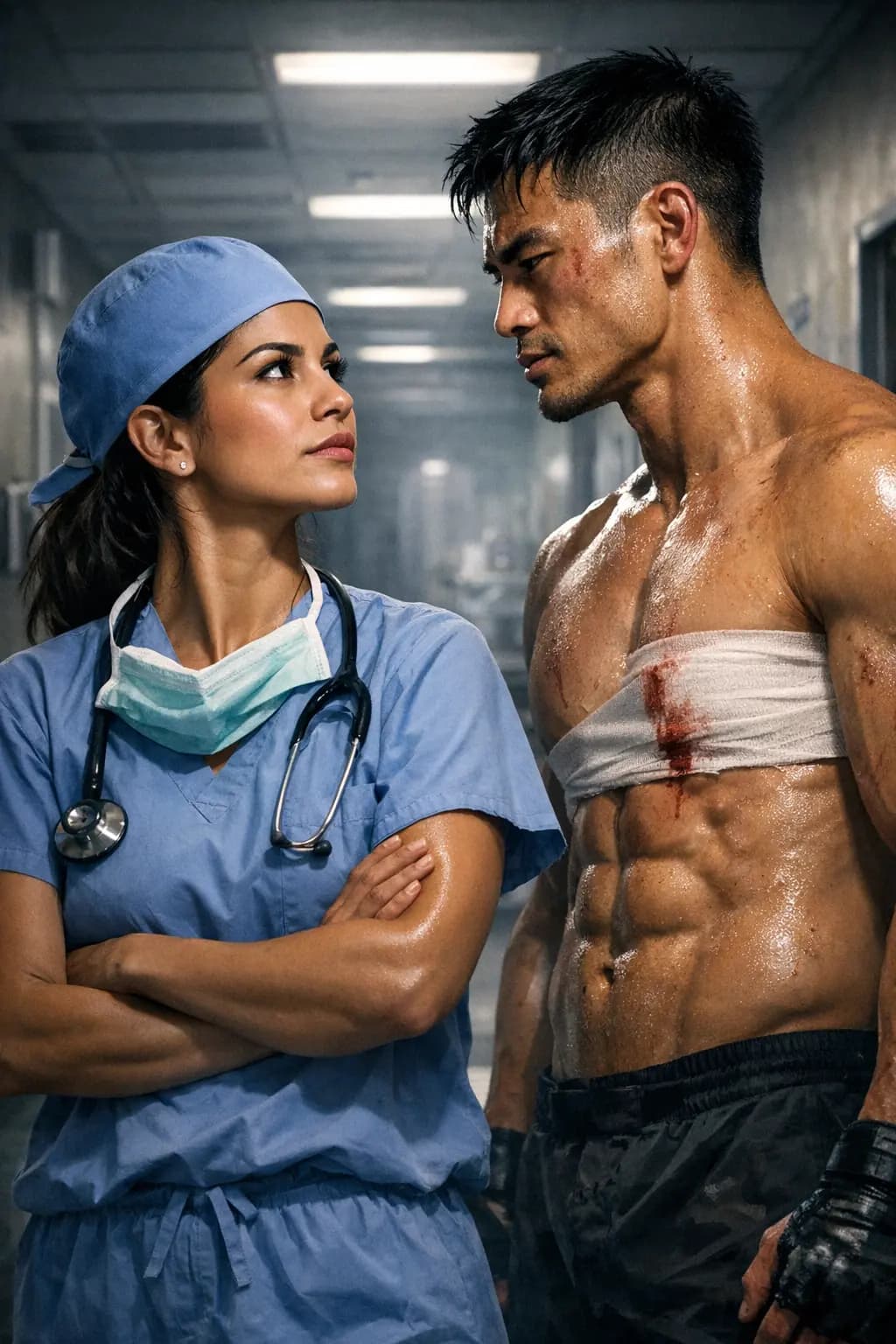
Tap Out
2.3K likes3.8K reads
Blood has a smell.
Most people don't know that. They think it's metallic, like copper pennies. It's not. It's organic. Alive. The smell of tissue fighting to heal itself, of iron oxidizing in air, of life refusing to quit.
I've smelled enough of it to know.
"Crash coming in! GSW to the chest, ETA two minutes!"
I'm already moving. Coffee abandoned. Coat on. Gloves snapping over my fingers with the efficiency of ten thousand repetitions.
The trauma bay lights are too bright. They always are. Everything washed in clinical white, the better to see what we're working with.
The doors burst open.
They wheel him in fast, gurney rattling, EMTs shouting vitals, a mess of tubes and blood-soaked gauze. Male, early thirties, built like a Greek statue and bleeding like a faucet.
"Gunshot wound, upper left chest. Entry no exit. BP crashing, pulse thready..."
I'm at the table before they finish. My hands find the wound automatically. Pressing. Assessing.
"He was already prepped for surgery when it happened," one of the EMTs says. "Some kind of altercation backstage. Security couldn't stop the shooter."
I don't care about the story. I care about the hole in his chest and the way his vitals are dropping.
"Type and cross for four units. Call upstairs, tell them I need an OR now."
My fingers probe the wound. The bullet's lodged somewhere near the subclavian. If it nicked the artery, he's got minutes.
"Dr. Vega..." One of the residents is staring at the patient's face. "That's, that's Jensen Tanaka."
"I don't care if he's the Pope." I lean closer to the wound. "Get me imaging."
"The UFC fighter. He's got a title match in two weeks..."
"He's not going to have anything if you don't move."
She moves.
I work.
This is what I do. This is what I've always done. Take the chaos, the blood, the desperate fragility of human bodies, and impose order. Find the problem. Fix it. Move on.
The imaging comes back. The bullet's millimeters from the subclavian. A shift, a sneeze, a too-deep breath, and he's dead.
"OR's ready."
"Then let's go."
We move fast. Through the halls, into the elevator, the fluorescent lights streaming past like we're entering hyperspace. His vitals are stabilizing, barely, the blood transfusion buying us time.
The OR is my church. Sterile, precise, controlled. Everything I'm not in the rest of my life.
I scrub in. The routine calms me. Brush, lather, rinse. Gloves on. Gown tied. Mask secured.
When I step to the table, he's prepped and draped, nothing visible but the wound and the monitors tracking his fading hold on life.
"Let's get this bullet out."
I make the first incision.
Three hours later, I'm staring at his chest cavity when he codes.
The bullet was harder to reach than imaging suggested. Scar tissue from old injuries, this man has been hit before, broken before, healed badly and kept going. His body is a roadmap of violence.
The monitors scream. Flatline.
"Charge to 200!"
My hands are already in position. Compressions. One, two, three, four,
"Clear!"
The shock runs through him. Nothing.
"Charge to 300!"
One, two, three, four,
"Clear!"
His body arches. The monitor stutters.
Then beeps. Steady. Alive.
"Welcome back," I mutter to his unconscious form. "Don't do that again."
The rest of the surgery is routine. Extract the bullet, a 9mm, badly fragmented. Repair the vessel. Close the wound. Check the vitals.
By the time I strip off my gloves, he's stable. Breathing. His heart beating in the steady rhythm of someone who doesn't know how close they came to stopping.
I should go. Write my notes. Move on to the next case.
Instead, I stand there. Looking at him.
He's attractive, in a brutal kind of way. Strong jaw. Dark hair. Features that would be pretty if not for the evidence of too many fists, a slightly crooked nose, a scar through one eyebrow, the kind of wear that comes from using your face as a shield.
A fighter. A professional one, apparently.
I've seen the UFC promos my brother watches. The violence packaged as entertainment. Men beating each other bloody for money, for glory, for whatever validation they're searching for in the octagon.
I hate it.
And now I've just spent three hours keeping one of them alive.
"Nice work, Dr. Vega." Dr. Patterson, the attending, claps me on the shoulder. "That subclavian repair was textbook."
"He coded on the table."
"And you brought him back. That's what matters."
I don't respond. The thing about saving lives is that it doesn't feel noble anymore. It just feels like work.
I head to the recovery ward to check on him one last time before I leave. Standing over his bed, watching the monitors blink, the IV drip, the steady rise and fall of his chest.
He'll wake up. He'll recover. He'll go back to getting hit for a living.
And I'll be here, cleaning up the aftermath.
"Hey."
The voice is rough. Ragged. Barely above a whisper.
His eyes are open. Dark, unfocused, but open.
"You're awake." I check his vitals automatically. Everything stable. "How do you feel?"
"Like someone dug around in my chest."
"Someone did. Me."
He blinks. Processing. Then, slowly, a smile spreads across his face. It transforms him, the brutal features softening into something almost warm.
"You saved my life."
"That's my job."
"Then you're good at your job." He winces, shifting slightly. "What's your name?"
"Dr. Vega."
"Dr. Vega." He says it like he's memorizing it. "I'm Jensen."
"I know."
"You a fan?"
"No."
The bluntness doesn't seem to bother him. If anything, his smile widens.
"Good. I'm tired of fans." He coughs, winces again. "So what happens now?"
"Now you rest. You'll be here at least a week. Then physical therapy. You won't be fighting anytime soon."
"I have a title match in two weeks."
"You have a hole in your chest and a repaired subclavian artery. The title match isn't happening."
His expression doesn't change, but something flickers in his eyes. Not anger. Something deeper. Sadder.
"Yeah," he says quietly. "I figured."
I should leave. I have notes to write, other patients to check, a shift that doesn't end for another four hours.
But there's something about the way he's looking at me. Not with the arrogance I expected from someone in his profession. Not with the entitlement of a man who makes millions getting hit.
He's looking at me like I'm a person. Like I matter.
"You should rest," I say.
"I know." He doesn't close his eyes. "Hey, Dr. Vega?"
"What?"
"You owe me dinner."
I blink. "Excuse me?"
"You saved my life. That means you're responsible for me now. Pretty sure that's how it works."
"That's not how anything works."
"Then we'll make new rules." He's smiling again, that unexpected warmth. "One dinner. When I can eat solid food. Let me thank you properly."
"No."
"No?"
"I save dozens of lives a week. I don't have dinner with all of them."
"But you could have dinner with one." He shifts again, winces. "Think about it."
"I won't."
"You will."
I turn and walk out of the room before he can see that he's probably right.