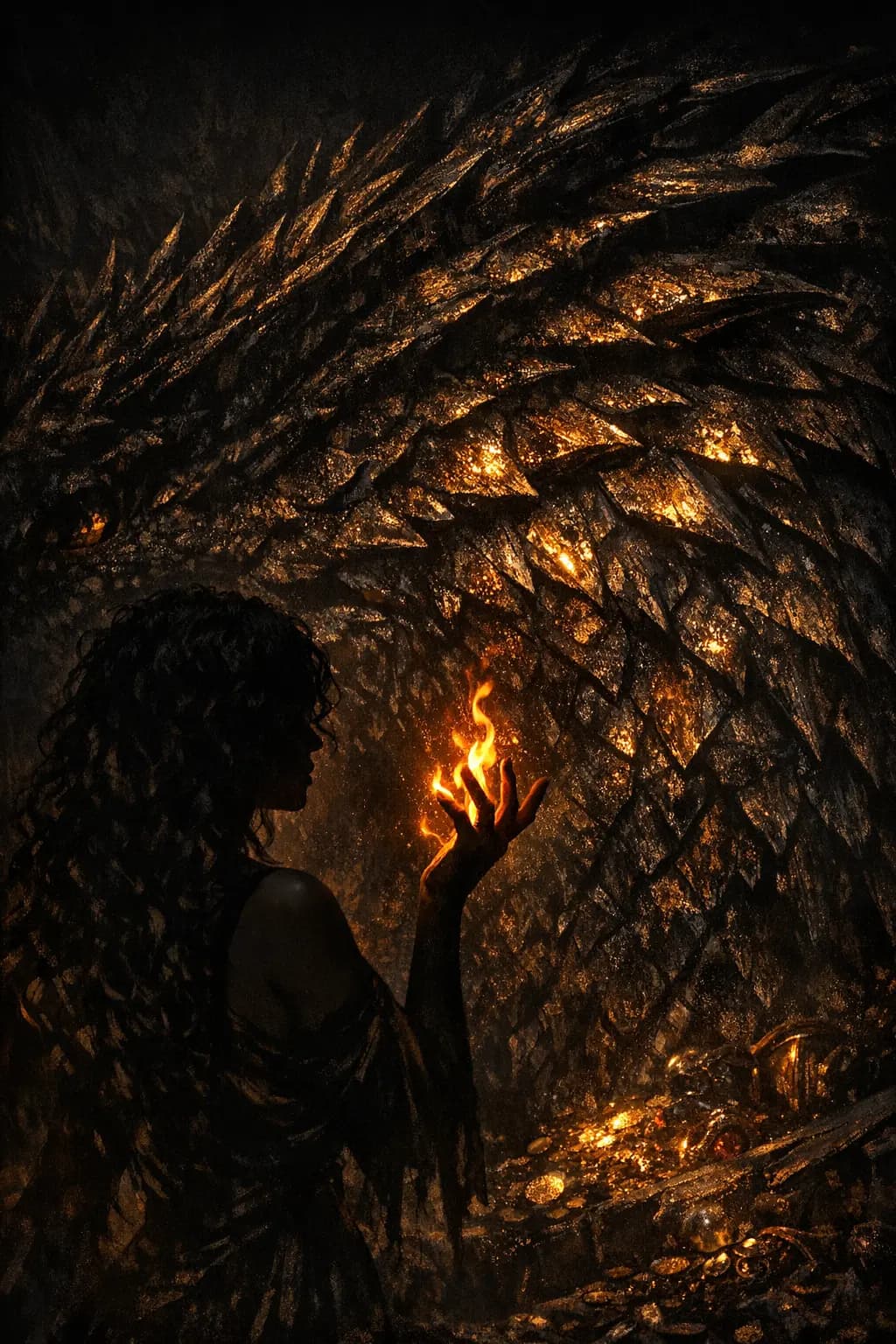
The Dragon's Debt
13.7K likes22.5K reads
I had a rule about jobs that paid forty-seven gold pieces. The rule was: refuse them. Forty-seven was a stupid number. Clean jobs round. Dangerous jobs round the other way. Forty-seven meant someone had counted, and someone who counted had a reason to remember.
I took it anyway. Petar had three weeks before Hadrik turned the loan into something else, and I did not have forty-seven days to be careful.
The vault was an old shrine in the foothills, wards on the door I could see and wards on the windows I could not. I worked the door's weave for an hour and found the seam my mother had taught me to look for — the place where two casters had not aligned their breath. Slack work, made by someone who had not expected anyone to come.
I went in.
It was a hoard, but not the kind in the temple murals. There was no pile. There were shelves, and objects on the shelves with labels in a script I could not read. A wooden horse the size of my hand. A silver chalice on a velvet pad. Three paintings under cloth.
At the back of the third aisle, a tray of loose coins. Gold. Not stacked. Scattered, like someone had been counting and stopped.
I did not touch the horse. I did not touch the chalice. I took the loose coins because they were the only thing in that vault that did not have a place. Forty-seven of them, every one weighing exactly the same in my palm, and I knew, the way a fence knows what she does not want to know, that they had been counted before I got there.
I made it down the trail. I made it through the foothill pass and onto the ridge road, and somewhere on the harbor wall the air around me got warmer.
Not summer warmer. Forge warmer.
A voice behind me said, "Soraya."
Not thief. Not girl. My name. The full one, the one Petar used and our mother had used and no one outside the harbor walls had used since she died.
I turned.
The man in the harbor street stood as if he had grown there. Tall. Black coat, black hair past his shoulders, gold-brown skin. His eyes were amber, and they were not glowing. That was almost worse — they were the eyes of something that could glow and was choosing not to.
He held the air between us at the temperature of a forge and let me feel it.
"You took forty-seven coins," he said.
"I did."
"From my hoard."
"Yes."
Two passersby looked at him and looked away as if they had been told not to remember him. I noticed without meaning to. I noticed everything. It was the only thing I had ever been good at.
"You will come with me."
"To where."
"My keep."
"To pay in what."
"Years."
I had three escape routes from this corner — the cooper's alley, the laundry yards, the wall. I had walked these streets since I could walk. I did not run. I knew what would happen if I did.
"How many."
"Forty-seven."
He said it the way he had said Soraya , like it was a sound he had paid for. Forty-seven, said by him, was not a number. It was a measurement.
"That is a lifetime."
"Mine has been many. Yours will be one. The exchange is fair."
I laughed, because the alternative was something I was not going to do in the harbor street. "Fair."
"By contract."
"Whose contract."
"You signed by entering the wards."
I had not signed anything. I had stepped through a crack a half-asleep ward-caster had left in the door's weave. But signed by entering was the kind of clause my mother used to translate for fences. I knew it the way I knew the harbor.
He took one step. The cold came back to the street where he had been standing. He had moved a step and the temperature had moved with him.
"And if I refuse."
"You will not. The wards are on you now. They are on me. We are bound by the same paper."
I looked at my right hand. Under the skin, beneath where a vein should have been, a faint red line. Not a tattoo. Not a brand yet. A suggestion of one, flushed the dull red of a fresh burn.
"What is your name," I said. I did not look up.
"Kiran."
"Kiran what."
"Kiran of the Black Mountain. The Lord of the Keep."
"Kiran will do." I closed my fist around the gold line under my skin. It did not hurt. That was the worst part.
He held out one hand, palm up. "Walk."
I walked.
I will not tell you about the road, the climb, the gate, the moment I crossed the wardline and felt the gold under my wrist root, the way a tooth roots into bone.
He brought me into a hall of black basalt and old gold. The floor was warm. Not hot — warm, the way a body is warm under a blanket. He pointed to a chair.
"Sit, Soraya."
I sat. He sat across from me, and he did not move.
The first hour, I thought he was waiting for me to speak. I did not speak. I had spent nine winters in the harbor learning to wait longer than the man across from me. I sat. I watched the brazier. I counted the bells.
The bells rang every third hour. I learned that in the second hour, when the first struck — a sound deeper than any bell I had heard, the kind that gets into the floor and travels up the bones into the teeth.
The second hour, I thought he was watching the brazier. He was not. The brazier did not move, and his eyes did not move, and his eyes were on me. Not staring. Holding. The way a man holds a cup of water he does not yet intend to drink.
The third hour, I thought I was going to scream.
I did not. I sat. He sat. The brand under my wrist warmed by half a degree. The third bell rang. He lifted his face from where it had been all three hours and I realized , the way a fence realizes a job is going to ask more than she has, that he had not blinked the entire time.
Not not blinked recently. Not blinked at all. In three hours.
He stood. The warm floor warmed another degree.
"You will sleep. Veska will show you the room."
"Lord of the Black Mountain."
"Yes."
"How does a nine-hundred-year-old creature pass forty-seven years."
He looked at me for a long moment. The amber in his eyes did a thing , became measured, not bright, not cold, the look of a creature deciding what to show me, and when.
"Slowly," he said.
He left.
A woman came in. Older than my mother had been when she died, gray-streaked hair, hands stained with resin. She did not speak. She gestured, and I followed, and the brand under my wrist warmed when I stood and cooled when I walked away from the hall.
I understood, by the time she pushed open the door of a chamber too large for one person, what the coin had bought me.
I understood that he had not moved in three hours because he could.
The question I had asked in the hall — how does a nine-hundred-year-old creature pass forty-seven years — was not a question anymore.
It was an answer.
The answer was: I am in his time now.