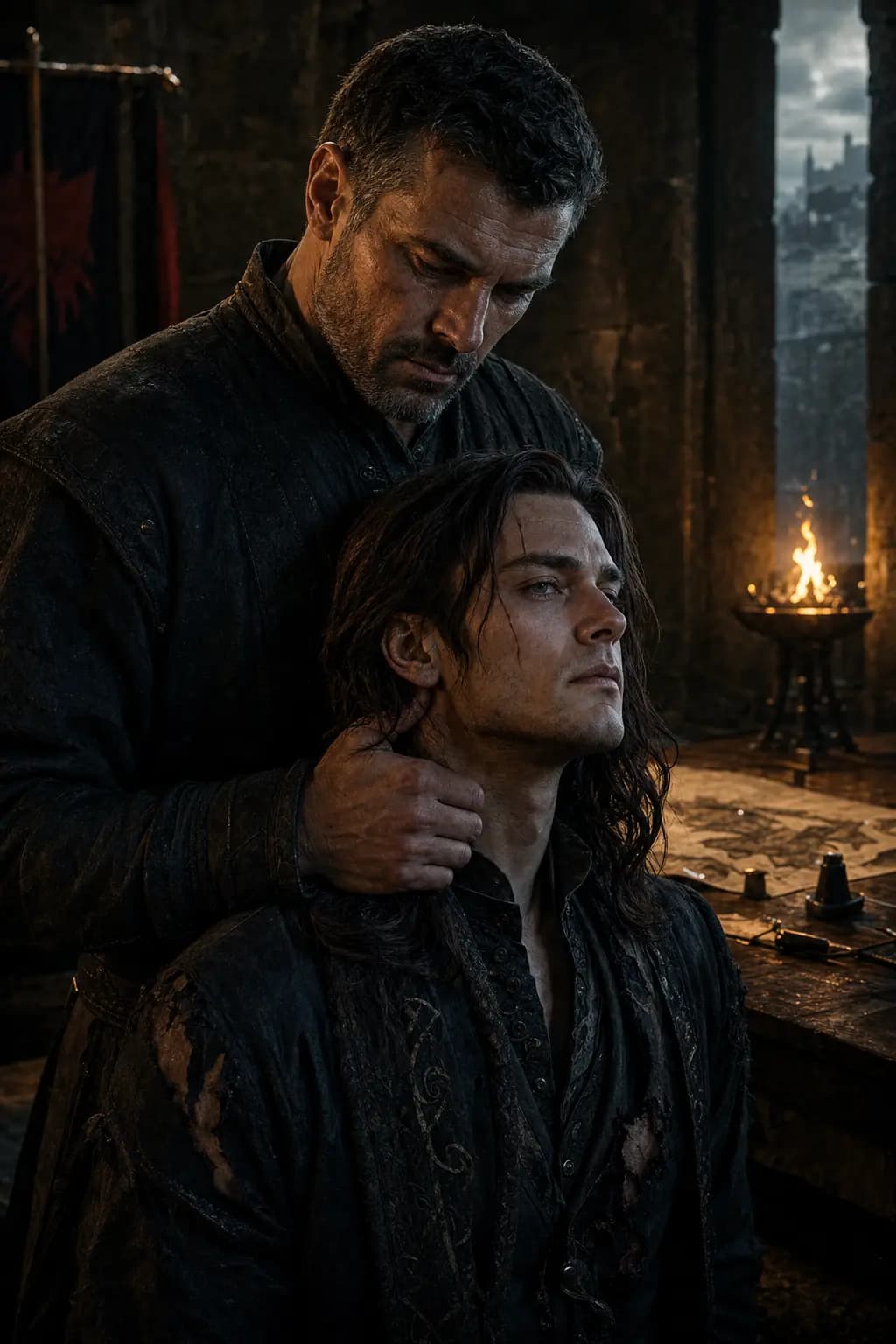
The Hostage Crown
939 likes1.5K reads
"Kneel," the conqueror said, the way another man might offer a chair.
I did not. I had read the terms over twice, by the light of a brazier his men had lit in a room that had been my brother's, and a Haldane did not kneel because a victor wished it. I told him so, in the court formal, evenly, the way I would have told an envoy his king's offer was beneath the table it was laid on.
He did not repeat himself. He did not raise his voice. He let the silence be the argument, and the silence held a city in it.
I knew the shape of the city it held. Three days ago the outer wall had come down where the river gate met the curtain, and the sound it made was not the sound I had spent a year of councils preparing for. I had prepared for a breach like thunder. It came like a long exhale, stone giving up a thing it had held since before my grandfather, and through the gap they came, and by the second morning the square below the cathedral was full in a way a square is not meant to be full. My brother was in it. They had let me see that much. A king should be seen, the captain had said, and Theron had been a king for nine days, and so they had laid him where a king could be seen, and I had stood at the slit window of this room and made my face do nothing, because there were men watching to learn whether the last Haldane would do something, and I would not give them the something.
"The terms," the conqueror said, "do not change because you stand."
He was the patient kind. I had heard that of him before the walls came down, in the way you hear of weather coming, and I had not believed it the way you do not believe in weather you have not yet stood in. Big through the shoulders, a soldier's frame kept hard, dark hair going grey at the temples in a short campaigner's cut. He dressed like a captain and not a king. No crown. No jewel. A man who did not need the room to be told who he was.
I read the terms a third time, because reading was the one thing left that was mine. The hand they were written in was plain and unhurried, and the offer was plain and unhurried, and the knife in it was so plain I had nearly walked past it.
The citadel still held. My people who had not been in the square were behind its inner gate, and behind that gate they would starve in a month or be put to the sword in a day, the conqueror's choice, and his choice was a thing he was setting on the table beside me like a man laying down a winning tile without hurry. The terms spared them. The terms spared the city from the sack a taken city is owed. In exchange the terms took one thing.
They took me.
Not my fealty. Not my treasure, which was ash. Not a ransom, which there was no House left to pay. They took my person. My presence, my parole, my keeping. I was to be surety, sworn between two crowns, held by him for as long as the bond held, and while it held, the citadel stood and the city lived and my people were not laid in any square for anyone to learn anything from.
"You wrote this," I said, "knowing I would read it for the trick."
"I wrote it knowing you would read it three times," he said.
"There is no trick in it."
"There is none to find," he agreed, without turning from the brazier. "You may stop looking."
That was the trick. That there was none. A lesser conqueror would have dressed it, called me guest, called the keeping honor, and I would have had the dressing to argue with. He had given me nothing to argue with except the thing itself, the bare arithmetic of it, a city for a man, and he was not even watching to see it land. He had turned half away to the brazier and was warming the backs of his hands, and that was somehow the worst of it, that my whole future was a thing he could set down and warm his hands beside.
I thought of the postern. There would be one. There was always one, an east door or a sally port, watched but not sealed, because a keep this old was built to let men out as much as keep them in, and a clever prince three days a captive was already thinking of the dark stair he had not yet found. I thought of it the way you think of a knife you have not yet decided to reach for.
And then I knelt, because a city.
The stone was colder than I had braced for. River cold, the cold that comes up through a boat, and it found my knees through the cloth and I made the diplomat's first mistake, the one I had not made in ten years of hostile rooms: I let it show. A tremor, small, the kind a man can blame on three days without sleep and a wound at his temple half-healed and the long cold of a sacked keep. I told myself it was the cold.
He crouched. He set two fingers to the line of my spine, between the shoulder blades, the way a steward straightens a banner before a guest arrives, unhurried, and pressed, the smallest correction, until my back came up out of its slump into the line he wanted.
"There," he said. Nothing more.
I held it. I held the posture the way I had held a treaty table when the men across it knew my granary was three weeks from empty and I needed them not to know I knew. I held it and the tremor did not stop and I despised, with a clarity that frightened me, the part of me, low and animal and underneath all the formal, that was waiting to be told I had held it well.
He stood. He did not tell me. He looked at me a moment, at where my eyes had gone, which was to the cold floor and not up, and something passed over his face that I did not have a name for and did not trust, because I trust nothing I cannot name.
"You start," he said, almost to himself, "from further down than most." He did not explain it. I would learn he rarely explained anything; the explaining would have been a kindness, and kindness was not a thing he performed. He only, sometimes, committed it.
He went to the door. A guard moved aside for him without being told.
"We continue at dusk," he said. "Tonight you sleep."
The door closed. The brazier ticked. I stayed on the cold stone a moment longer than the terms required, on my knees in my brother's room, and then I rose, and crossed to the slit window, and did not look at the square.
One hand had come up to my own throat, to the bare line where a Haldane wore the House signet and where now there was only a pale band of unburnt skin. There was no collar there. He had put nothing there. My hand was at my throat anyway, not pulling, just resting, the way you press a wound to know it is still yours.
I should be planning the postern.
I was thinking about the posture.