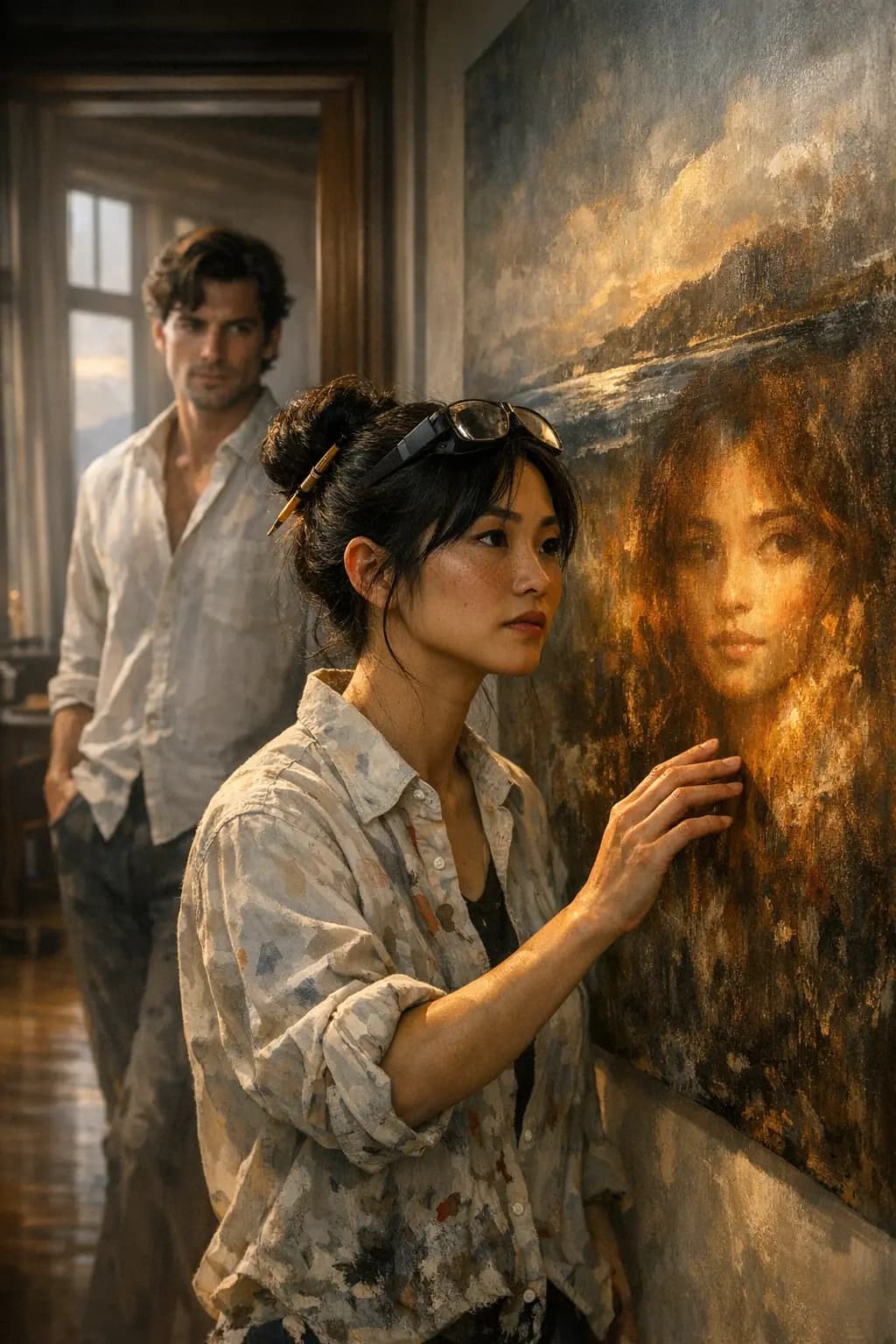
The Island Restoration
695 likes1.1K reads
The last time someone offered me this much money, I ended up crying in a Walgreens parking lot, so you can understand my hesitation.
"Three weeks," the estate lawyer says through my phone speaker. "Full room and board. The ferry runs twice daily, but the client prefers minimal disruption."
I'm sitting on the floor of my former gallery, which is now just a room with excellent lighting and a past-due notice taped to the door. My dinner is instant ramen. The good kind, with the egg. I'm living the dream.
"How much did you say the commission was?"
He repeats the number. My chopsticks clattered against the bowl.
"And the collection is... forty-two paintings?"
"Forty-two cataloged works. Oil on canvas, mixed provenance, primarily mid-century. The client requires a full condition assessment, conservation recommendations, and restoration where indicated."
My synesthesia hums. It does that sometimes with numbers, with potential. Copper at the edges, like tasting a new pigment for the first time.
"Who's the client?"
"Beckett Astor. He inherited the collection from his grandmother, Rosalind Astor. The estate is on Cross Island. I should mention," he pauses, "Mr. Astor maintains a focused work environment. Limited phone access on the property."
"Limited as in..."
"He'll hold your phone at the door." "It's in the contract," he adds, as if that makes it normal. "Section four, clause seven. Focused work environment provisions."
I laugh. Then I realize he's not laughing.
"You're serious."
"Mr. Astor is particular about his process."
His process. For my work. Already off to a great start.
I look around my empty gallery. At the notice on the door. At the ramen.
"When do I start?"
Three days later, I'm standing on a ferry dock with two cases of restoration supplies and a duffle bag that smells like linseed oil, watching an island materialize through morning fog.
Cross Island is smaller than I expected. A dark smudge of evergreen and stone, maybe two miles end to end, with a single dock reaching into grey water like a beckoning finger. There's one house visible from the channel, a large one, stone and timber, half-swallowed by ivy on the east face.
The ferry bumps the dock. I grab my cases.
A man is waiting at the end of the pier. Tall. Dark brown hair pushed back from a face that looks like it was designed for disapproval. White linen shirt, collar open, sleeves precise. He's holding a clipboard.
A clipboard. To meet the art conservator. I cannot stress enough that this man has a clipboard.
"Ms. Chen."
"That's me."
"Beckett Astor." He doesn't offer a hand. He's already looking at my equipment cases. "Those are Gaylord archival cases."
"Yes."
"The model 7 or the 12?"
I blink at him. "The 12. The 7 doesn't fit my UV rig."
He nods, as if I've passed some test I didn't know I was taking, and turns toward the house. "The collection is in three rooms on the ground floor. North-facing light. I installed climate control eighteen months ago. Sixty-eight degrees, forty-five percent humidity."
He's walking. I'm apparently supposed to follow. He hasn't offered to carry anything.
"The paintings are arranged chronologically by acquisition date. I have a catalog, but the provenance documentation is incomplete for approximately a third of the collection."
"I'll need access to the storage areas, any correspondence about the purchases, and the original framing records if they exist."
He stops walking. Turns. The look he gives me is, well, like I've surprised him by knowing my own profession. Like I said something he wasn't expecting.
"The framing records are in the library. I'll have Dot show you."
"Dot?"
"Dorothy Callahan. The housekeeper. She's been with the estate since my grandmother's time."
He starts walking again. I follow, dragging my cases up a gravel path lined with rosebushes that have been left to grow wild. Beautiful, actually. Overgrown in a way that suggests someone used to tend them, and someone else decided not to.
The house is stunning up close. Arts and Crafts architecture, original details, clearly loved and maintained. Beckett opens the front door and holds it, and for one second I think, okay, maybe he has manners.
Then he holds out his other hand, palm up.
"Your phone, please."
"You're really doing this."
"Focused work environment."
"That's not a real thing."
"It's a very real thing. Ms. Chen, the collection requires your full attention. The nearest reliable cell signal is on the east cliff, a fifteen-minute walk. You're welcome to use it during personal time."
I pull my phone from my jacket. Our fingers don't touch during the handoff. He places it in a drawer by the door with the precision of a man filing tax documents.
"The gallery is through here," he says, and walks me into the most beautiful room I've ever worked in.
Forty-two paintings. Three connected rooms. Light pouring through tall windows, filtered by the island's grey sky into something luminous and even. The climate control hums a low, steady note that my brain translates as the color blue.
I lower my cases to the floor. My hands are already itching.
He's watching me look at the paintings. His attention lands on the side of my face, steady and cataloging, like he's grading my reaction the way I'll assess his grandmother's collection.
I stop in front of a seascape. Something in the ground layer catches me, a warmth underneath the surface blues that doesn't match the visible palette. Copper on my tongue. Faint, but there.
"This one," I say, and I don't mean to say it out loud.
"What about it?"
I look at him. He's standing with his hands at his sides, holding the frame of the painting next to him with one hand, fingers curved around the wood like he's cradling something alive.
Careful. He holds the paintings carefully.
I file that under infuriating and turn back to the seascape.
"Nothing. Just getting started."