The Understudy
2.5K likes4.1K reads
The lights go down.
My cue is in forty seconds and I can't feel my hands.
The audience goes quiet, that particular hush where a thousand strangers become one breathing animal, and I'm standing in the wings on the wrong side of the curtain, trying to remember how to swallow. Chase Bancroft's understudy. That's what the program says. That's what I've been for years, the backup plan nobody wanted to use.
Tonight the backup plan goes on.
If I choke, they'll write about it for weeks. Not because anyone cares about Mateo Torres, but because they love watching someone reach for something they don't deserve and miss.
"Thirty seconds." The stage manager's voice crackles in my earpiece.
I shake out my fingers. Roll my shoulders. Find my mark in the darkness.
My mother didn't come. Couldn't get off work, or couldn't be bothered, the distinction stopped mattering years ago. My father thinks I should be doing something real. And the man whose role I'm stealing is somewhere in this building, watching.
Don't fuck this up, Torres. This is your shot. Your only one.
"Places."
The music swells. The curtain rises.
And I walk into the light.
The first act tears through me.
The lines land without thinking, muscle memory doing the work while the rest of me just... lives in it. Michael, the character, a man caught between the brother he loves and the family legacy he's supposed to destroy. I've watched Chase play him eight shows a week. Smooth. Charming. Every gesture polished to a gleam.
I play it rough. Where Chase coaxes, I challenge. Where he seduces the audience, I dare them to look away.
By the end of act one, I can feel it, that restless hum in the house when something unexpected lands. When the understudy isn't just adequate.
"Jesus, Torres." Jordan, my castmate, grabs my arm as we exit for intermission. "Where the hell has that been hiding?"
"The wings," I say. "Watching."
Act two.
The heavy stuff. The confrontation scene. The breakdown that won Chase his first Tony nomination three years ago.
I've watched him do this scene probably five hundred times. I know every tear. Every crack in his voice. Every perfectly calibrated moment of vulnerability that makes the audience want to wrap him in a blanket and tell him everything will be okay.
I can't do it like that. I'm not Chase Bancroft, born to Broadway royalty, trained from childhood to cry on cue while looking beautiful.
So I don't try.
Michael's grief becomes something angular. Sharp. The kind of pain that doesn't break gracefully but shatters in jagged pieces. I play him angry, furious at the brother who betrayed him, furious at himself for not seeing it coming, furious at a world that keeps demanding he choose between love and survival.
There's a moment in the scene where Michael is supposed to sink to his knees. Chase always did it slowly, a gradual surrender that gave the audience time to reach for their tissues.
I drop like I've been shot. Like the weight of everything just became too much to hold.
The gasp from the audience hits me in the chest.
Oh god. Did I fuck it up? Was that too much?
But then I feel it, that silence. The one that means they're not breathing. The one that means you've got them in the palm of your hand and they don't want to let go.
I finish the scene. Exit. Make it to the wings before my legs give out.
Diana, our director, is waiting. She doesn't say anything. Just nods once, slow and deliberate, her face giving away nothing.
From her, that's practically a standing ovation.
The final scene. The curtain call. The roar.
I don't remember the ending. I must have said my lines, hit my marks, found my light, but all I remember is the curtain coming down and then rising again, and the wall of sound that hits me like a physical force.
Standing ovation.
The house erupts. Not polite applause, not obligation. The real thing, the kind that hits you in the sternum and makes your vision blur.
I bow, and the lights are too bright to see faces, but I can feel them. All of it landing on me, and the terrifying thought that if they take this away now, I won't survive it.
I bow again. The kid from Jersey who practiced Tony speeches in his bathroom mirror. On a Broadway stage. On his feet. Alive.
That's when I see him.
Stage left. In the shadows of the wing. Chase Bancroft, leaning on crutches, watching me receive his applause.
I catch him watching me from the wing.
I expect smugness. Condescension. The man who's spent years reminding me I'm "a real asset to the production" should be seething that I'm standing in his spotlight.
But he's not seething. His lips are parted. His weight is forward on the crutches, like he forgot he was leaning. He looks like a man who just watched his house burn down and can't decide if he's devastated or relieved.
My stomach flips.
The curtain comes down for the last time. The applause fades. The stage manager calls final places, and the crew starts striking the set.
I should go to my dressing room. Call my mom. Post something on Instagram. Do all the things you're supposed to do after the biggest night of your career.
Instead, I walk toward Chase.
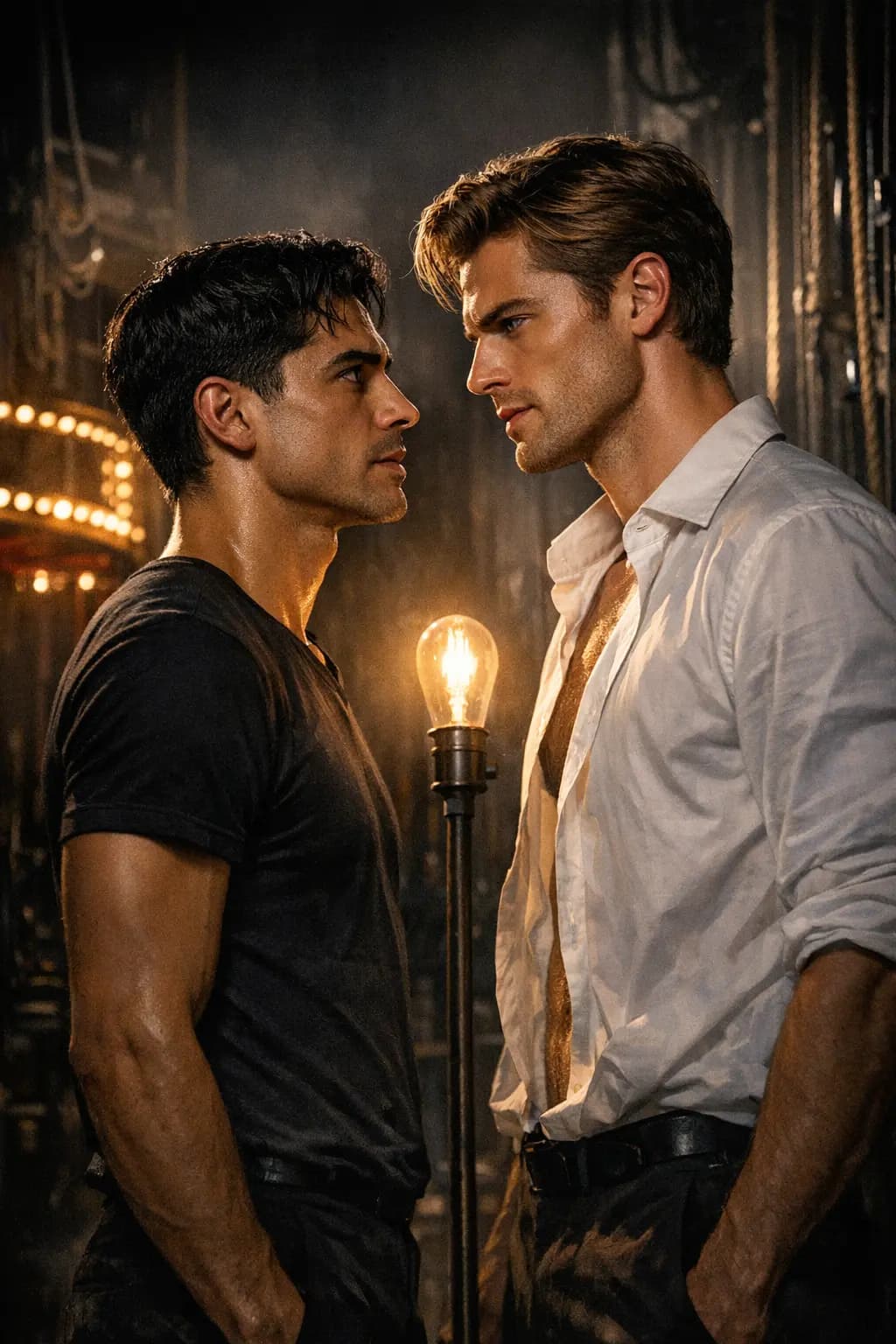
He watches me approach. Doesn't move. Doesn't speak. Just stands there in his expensive jeans and artfully rumpled henley, looking like a goddamn cologne ad even with a cast on his foot.
"Torres." His voice is exactly what it always is, smooth, confident, faintly amused. The voice of a man who's never had to audition for his own life.
"Bancroft."
We stand there, the ghost light the only illumination now, the empty theater stretching out behind us like a held breath.
"Not bad," he says finally. "Not bad at all."
Years of "not bad" and "almost there" and "keep working, you'll get it eventually." Years of being his backup, his safety net, his understudy.
I'm supposed to be gracious. Humble. Grateful for his blessing.
"Damn right it wasn't," I say instead.
His face cracks open. And he laughs.
Not the polished sound he uses at press events. A real laugh, surprised out of him, rough at the edges. It changes his whole face, makes him look younger, less armored.
"There it is," he says. "That's what they saw out there. That fire."
I don't know what to do with a Chase Bancroft who sounds like he means it.
"What are you doing here?" I ask. "Shouldn't you be somewhere being waited on?"
"Wanted to see the show." He shifts on his crutches. "My show."
"It's not your show tonight."
"No." He agrees easily, which throws me. "Tonight it was yours."
Neither of us speaks. I can hear the crew laughing somewhere backstage, the clatter of scenery being stored, the distant sound of the cleaning crew's vacuum in the house.
"The reviews will be out in a few hours," Chase says. "You should get some sleep."
"Can't. Too wired."
"I know the feeling." He starts moving toward the stage door, crutches clicking against the floor. Pauses. Looks back at me. "Torres."
"What?"
"You changed the blocking in the breakdown scene. The drop to the knees."
I tense. Here it comes. The criticism. The correction. Actually, here's how it should be done...
"It was better," Chase says.
And then he's gone, leaving me alone on an empty stage, standing in a spotlight that used to be his.
It was better. Like it cost him a tooth to say it.
I stand there for a long time after he leaves. The ghost light hums. The empty seats stare back at me.
Tomorrow the reviews drop. Tomorrow the producers want to talk about "the ongoing arrangement." Tomorrow I go back to being the understudy in a world that hasn't decided I'm allowed to be anything else.
But his laugh is still ringing in my ears. And something dangerous is coiling behind my ribs, not victory, not comfort, but the sick realization that Chase Bancroft's approval matters to me.
More than it should.