What She Made Me
530 likes869 reads
Lisbon smelled like salt and frying onions the moment I stepped off the plane, and I was already late.
My suitcase had a broken wheel. The taxi driver spoke no English and I spoke no Portuguese and we communicated through pointed fingers and the GPS on my phone, which kept rerouting through streets too narrow for a car. He dropped me two blocks from my rental apartment and charged me double. I overpaid because I didn't have the energy to argue, then stood on a cracked sidewalk in Alfama with one good suitcase wheel and a phone call I'd been avoiding for three hours.
I called Marcus back.
"You land and the first thing you do is ghost me." His voice had that clipped quality it gets when he's already decided how the conversation ends. "I need this piece, Juni."
"I just got here."
"Saudade. No online presence, no reviews, no photos, no social media. Just a waiting list that goes months. You know what that screams to me?"
"A feature piece."
"A con. I want you to gut it. 'Overrated spots that coast on mystique.' Give me something sharp. The editors want edge, not admiration."
I stood in the late-afternoon light and watched a woman hang laundry from a balcony three floors up. A tram ground around the corner below. The air was warm and carried grilled sardines from somewhere I couldn't see.
"This is your comeback piece," Marcus said. "Four months since your last byline. The Quarterly Table still talks about your exit. You need this to land."
He wasn't wrong. Four months of silence after the breakdown, after Tess left, after the world went flat and I stopped being the person who could make you hungry with a paragraph.
"I'll find the restaurant tonight," I said.
"Find it. Eat there. Write it up. Don't fall in love with the place. Fall in love with the angle."
He hung up. I dragged my suitcase over the cobblestones toward the apartment. The broken wheel screamed against the stone.
I almost didn't find Saudade at all.
Alfama is a neighborhood built for getting lost. The streets curve and climb and narrow until you're not sure you're on a street anymore. I'd been walking for twenty minutes, checking my phone against a pin someone had dropped in a forum post with no replies, when I passed a wooden door I'd already passed twice. No sign. No menu in the window. Just a door, slightly ajar, and the smell of garlic and lemon and something underneath, something warm and deep that made me stop walking.
I pushed the door open.
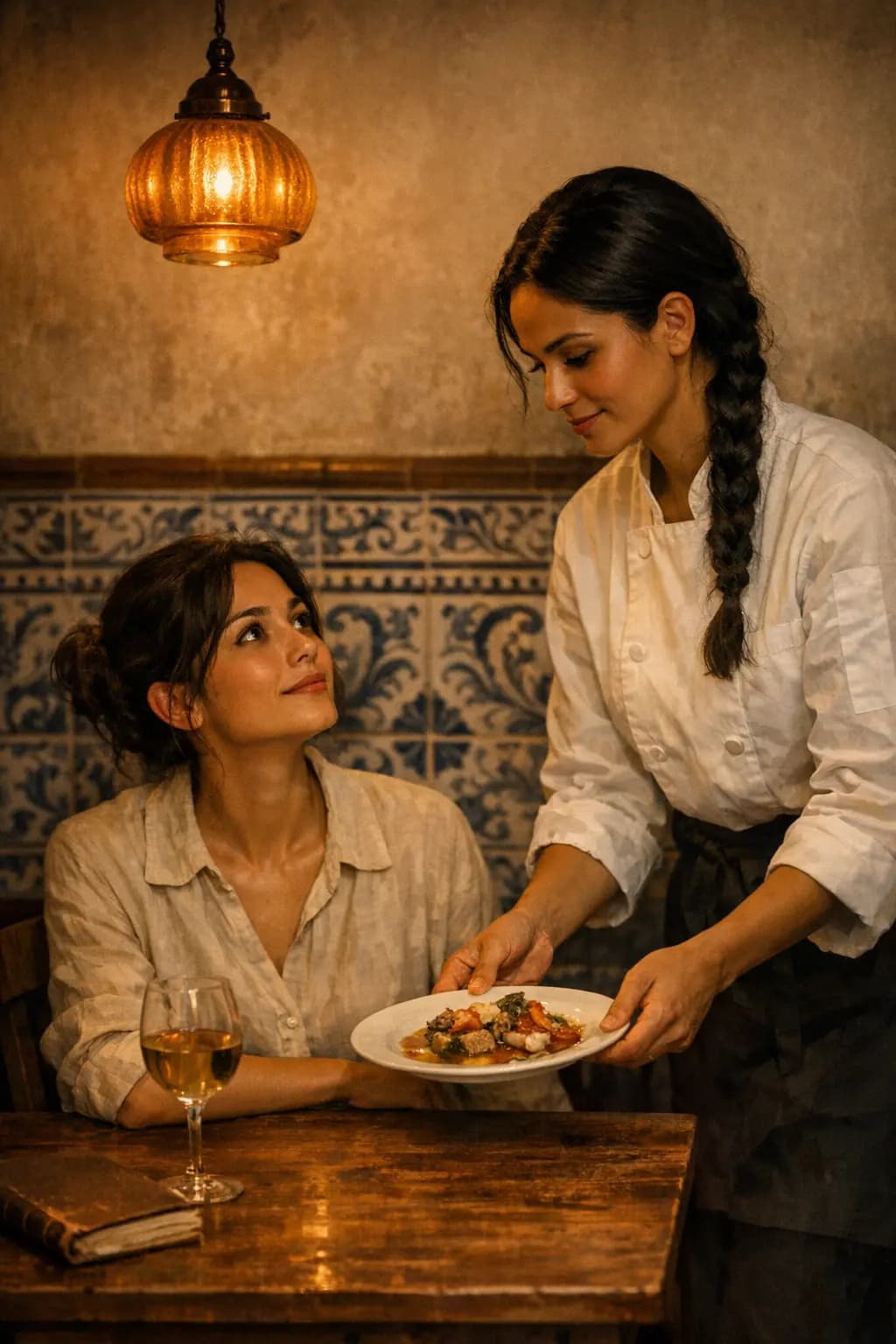
Inside: five small tables, azulejo tiles in white and blue on the walls, a few cracked. Warm light from amber pendants. An open archway to a kitchen where someone was moving. Three of the five tables were occupied. Nobody looked up.
A woman came out of the kitchen.
She was my age, maybe a few years older. Black hair in a thick braid. A cotton kitchen coat, white, the sleeves pushed to her elbows. She looked at me and didn't do the thing hosts do, that quick scan of the room to calculate open seats. She looked at my hands first. Then my shoulders. Then my face.
"Sit," she said. Not a question.
I didn't sit. I've walked into Michelin-starred kitchens and told the sommelier he was wrong about the vintage. I don't take orders from strangers in unmarked restaurants.
"Do you have a menu?"
"No."
"A specials board? A wine list?"
"Sit," she said again, and went back into the kitchen.
I sat. Partly because the smell coming from behind her was doing something to the back of my throat, garlic softened in olive oil, bread with a crust still cracking from the oven, a broth that had been building for hours. And partly because I wanted to see what she'd do next.
She didn't come back for ten minutes. I heard oil popping in a pan, the scrape of a knife on wood, something sizzling. On the wall beside me, an old photograph: a woman in the same kitchen, younger, darker hair, the same hands.
When she returned, she carried a shallow bowl. She set it down and stood there, watching.
Thin slices of white fish fanned across the bottom, almost translucent. A pale broth, barely colored. Three dark leaves floating at the surface. A drizzle of oil catching the amber light.
I picked up the fork because that's what you do. You eat.
The fish dissolved on my tongue.
And I tasted it.
I need to explain this. I hadn't tasted anything real in eight months. Not coffee, not bread, not the pho from the place on Delancey that used to make me cry. Psychosomatic ageusia, my therapist called it. Stress-induced. Eight months of chewing and swallowing and pretending, nodding at meals, saying "good, yeah" while my mouth registered nothing but temperature and texture. Warm mush. Cold crunch. The mechanical act of eating with all the meaning scraped out.
And then this.
The clean sweetness of the sea, delicate and cool. A slow warmth underneath, bonito shaved so fine it had melted into the oil. Brightness at the edges, citrus, not lemon, something sharper, yuzu maybe, lifting everything.
My eyes filled. I put the fork down. Pressed my hand over my mouth. The tears came and I couldn't stop them, not because the food was extraordinary, though it was, but because I had been numb for eight months and I was suddenly, violently present.
When I looked up, she was standing at the edge of the kitchen archway. Watching me. Not the plate. Me. The way you watch a song you recognize but can't quite place.
She crossed the room. Pulled out the chair across from me and sat down.
"You haven't eaten in a long time," she said. "Not really."
I wiped my face with the back of my hand. My voice was rough when I found it.
"How did you know what to bring me?"
She tilted her head. Studied me the same way she had at the door, eyes tracing hands, shoulders, the set of my jaw.
"I don't always know," she said. "Sometimes I get it wrong."
"You didn't get it wrong."
"No." A pause. She looked at the bowl, then back at me. "Tomorrow. Come earlier."
She stood and walked back to the kitchen.
I sat at the table for another hour. I opened my Moleskine and uncapped a pen. Marcus wanted a takedown. A restaurant with no sign, no menu, no online presence, run by a woman who looks at you like she's reading a language you didn't know you were speaking.
The page stayed blank.
Not because I had nothing to say. Because the question filling up my whole chest wasn't about the food. The food was extraordinary. But plenty of food is extraordinary, and none of it had made me taste again.
What I wanted to know was: how did she look at me for thirty seconds and cook the exact thing my body had been refusing for eight months?
And what else could she see that I couldn't?